
Free tools · Google Sheets

Job application tracker for Google Sheets

The same tracker, native in Sheets: a dashboard that counts itself, ten status stages, follow-up dates that turn red and a Quiet column that spots silence. One click makes your own copy — no signup, no email, nothing shared back to us.

  • No email required
  • No macros
  • Nothing sent to us
  • Free forever
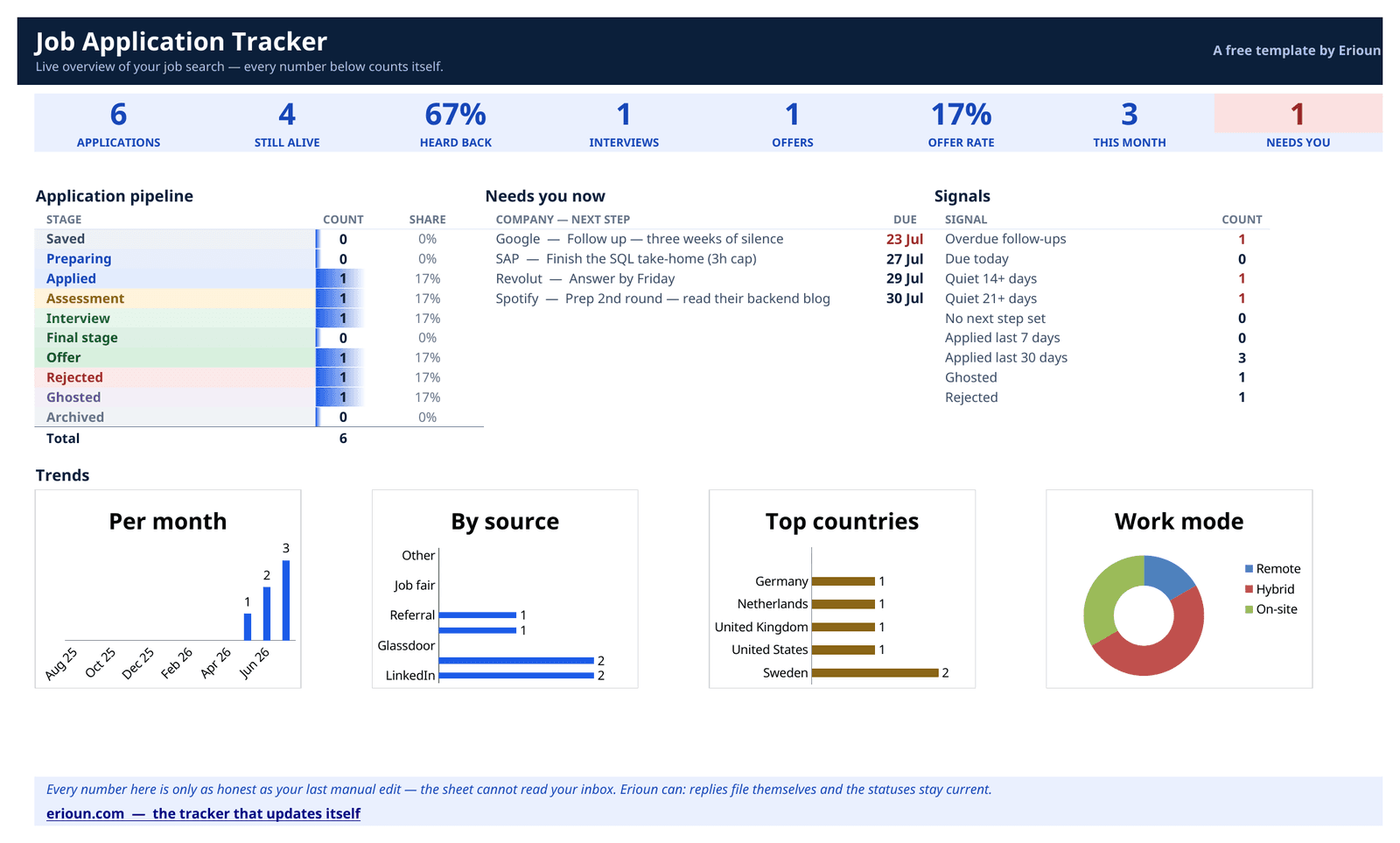
The Google Sheets job application tracker's Dashboard: eight counters, the pipeline by stage, a Needs you now list and four charts.

Get the Google Sheets template

Free, no macros, no signup, yours to keep. The file downloads the moment you click.

See it before you download it

Both shots are the real Google Sheets file, opened and rendered — not a mockup. The figures come from the six example rows it ships with.

The tracker's Dashboard: eight counters across the top, the pipeline broken down by stage, a Needs you now list, a Signals panel, and four charts.
The Dashboard. Nothing here is typed — every figure counts itself from the sheet next door.
The Applications sheet: one row per application, with a colour-coded status column, a red overdue follow-up date, and a Quiet column counting days of silence.
The Applications sheet. Status colour-codes itself, a late follow-up turns red, and Quiet counts the silence.

What makes this one different

Most free job application tracker templates are a blank grid with a status column. This one does four things on its own.

A dashboard that counts itself

Eight live counters — applications, still alive, heard back, interviews, offers, offer rate, this month, and how many things need you today. Under them: your pipeline across all ten stages, the next things due, and four charts covering months, sources, countries and work mode. You never type a number into it.

A column that spots ghosting

Quiet counts the days since anything last happened on each application — their reply if there was one, otherwise the day you applied. Amber at 14 days, red at 21, blank once it's closed. It is the one thing a spreadsheet can genuinely work out on your behalf, and most templates don't.

Follow-ups that refuse to be forgotten

Every row gets a next step and a due date. Overdue dates turn red, today's turn amber, and the Dashboard lists whatever is soonest. It also counts the live applications you've left without a next step — the ones that quietly fall out of a job search.

Nothing to install, nothing phoning home

No macros, no add-ons, no scripts, and — in the standard file — not a single request to the internet. Nothing about who you're applying to leaves your machine. No email address is required to download it either.

What's inside the Google Sheets template

The columns that answer “what did I send, to whom, and what's next?” — and not one more. Two of them fill themselves in.

Every morning

The block that drives your day — and it fits on any screen without scrolling sideways.

Company
Who you applied to.
Position
The exact title from the posting.
Status
One of ten stages, Saved through Archived. Colour-codes itself.
Next step
The one thing to do next. Never leave it empty.
Due
When to do it. Goes amber today, red once it's late.
Quiet
Days since anything happened — fills itself in. Amber at 14, red at 21.

When something happens

The two dates that make the response rate and the silence-spotting work.

Applied
The date it actually went out.
Last reply
When you last heard from them. Drives the response rate.

Worth knowing later

Context you'll want when three offers land at once — or when none do.

Country
Pick from the list — feeds the top-countries chart.
City
Where the role sits.
Work mode
Remote, hybrid or on-site.
Salary
Posted or guessed — with its own currency column, so the average means something.
CV used
Which CV they have — the thing everyone forgets.
Email used
Which address you applied from, when you run more than one.
Source
Where you found the role.
Job link
The posting, before it disappears.
Notes
Anything future you will want to know.

Status stages: Saved · Preparing · Applied · Assessment · Interview · Final stage · Offer · Rejected · Ghosted · Archived — the same ten stages Erioun uses, so moving up later is a rename-free experience.

How to use it

  1. Make your own copy

    The button below opens Google's "Make a copy" prompt. The copy lands in your Drive and belongs to you — the original is read-only and we never see yours.

  2. Add a row the day you apply

    Company, position, the date and which CV went out. Country, status, source, work mode and CV are dropdowns, so most of a row is four clicks.

  3. Always fill Next step and Due

    The Needs you now panel on the Dashboard reads those two columns. Leave the date blank and the application quietly disappears from your day — the Signals panel counts how many you've done that to.

  4. Open the Dashboard each morning

    Eight counters, your pipeline by stage, the next things due and the silence worth chasing. Work top-down and close the tab.

Frequently asked

Do I need to ask for access?

No. The template is public and read-only, and the button opens Google's own "Make a copy" screen. You never request access to ours, and we never get access to yours — your copy lives in your Drive under your account.

Does the tracker work in the Google Sheets mobile app?

Yes. There are no scripts or add-ons anywhere in it, so everything works in the Sheets app on Android and iOS — the dropdowns, the colour-coding and the dashboard counters included. The dashboard is designed for a wide screen, so it reads best on a laptop.

How do the status dropdowns work in Google Sheets?

The Status column uses Sheets' built-in data validation with ten stages: Saved, Preparing, Applied, Assessment, Interview, Final stage, Offer, Rejected, Ghosted and Archived. Tap a cell and pick. Each stage colour-codes itself, closed applications grey out their whole row, and every count and chart reads that one column.

What does the Quiet column do?

It counts the days since the last thing that happened on each application — their reply if there was one, otherwise the day you applied. Amber at 14 days, red at 21, and blank once the application is closed, so it only nags about things still worth chasing.

Can I share the sheet with a coach or a friend?

Yes — your copy is a normal Google Sheet, so standard sharing applies. Give view access for accountability, or edit access if someone is helping you run the search.

What happens when the spreadsheet gets big?

Honestly: upkeep grows with every row. Around 20-30 active applications, updating statuses and reply dates by hand becomes its own chore, and the sheet is only ever as current as your last honest edit. That's the point where a tracker that updates itself — like Erioun — starts paying for the switch.

The honest upsell

This is the manual version.

Erioun fills itself in — every application gets its own email address, replies file themselves and statuses stay current. You're always one tap from adjusting, and nothing is ever sent without you.